
Fused Deposition Modelling (FDM)
Want to get started? Call us on +61 3 8899 7280
or follow the button below to get instant pricing.


Contact Us Today
Trusted by Businesses Around the World


FDM – Fused Deposition Modelling
Fused deposition modelling (FDM) 3D printing, also known as fused filament fabrication (FFF), is an additive manufacturing process. Objects are constructed layer by layer using a thermoplastic filament that is extruded through a heated nozzle. FDM parts are made from the same families of thermoplastics used in moulding and machining, which makes the process well suited to functional prototypes, jigs and fixtures, and end-use parts.
FDM plays a pivotal role in modern industrial processes, from aerospace and automotive through to healthcare and manufacturing. Its ability to create functional prototypes, end-use parts, and jigs and fixtures has changed the way products are developed and brought to market, giving industries a reliable way to iterate quickly, validate designs and reduce lead times.
Why Use Our FDM Service?
At Formero, our FDM 3D printing is delivered across two platforms, giving access to a broad range of materials without compromising on quality or consistency. This includes the Markforged FX20 for composite and high-performance parts, alongside high-end, enclosed multi-material printers covering a broad range of general-purpose and engineering thermoplastics.
Running both platforms in-house means each job goes to the right machine and material for the application, whether that’s a concept model, a functional prototype or a working end-use part. All FDM parts are produced under our ISO 9001 quality system and can be quoted and ordered directly through our online quoting system.


Benefits of FDM 3D Printing
- Tough, Functional Parts: Thermoplastic parts that hold up in test rigs, housings, brackets and working assemblies.
- No Tooling Required: Parts are printed directly from CAD, so design changes between iterations only need an updated file, not a new mould or fixture.
- Wide Material Range: From general-purpose PLA and PETG through to ABS, ASA and polycarbonate, and high-performance options including ULTEM 9085. Static-dissipative grades are also available.
- Efficient for Larger Parts: Infill density can be adjusted to balance strength, weight and build time, making FDM well suited to bigger components.
- Fast Turnaround: Short lead times from file to finished part, with online quoting and ordering.
The Markforged FX20 Advantage
For advanced and high-performance jobs, we operate the Markforged FX20, a symbol of cutting-edge innovation in additive manufacturing. This printer excels in producing parts that meet the highest standards of strength, repeatability, speed and quality. With the Markforged FX20, you can expect consistent, repeatable results, making it an invaluable asset for industrial-grade applications.
The FX20 runs Markforged’s Onyx range, a composite material known for its strength, accuracy and consistent finish. Alongside standard Onyx, we offer Onyx FR for flame-retardant applications and Onyx ESD for static-dissipative parts, as well as ULTEM 9085 for high-temperature requirements.
Materials Available.
Onyx™
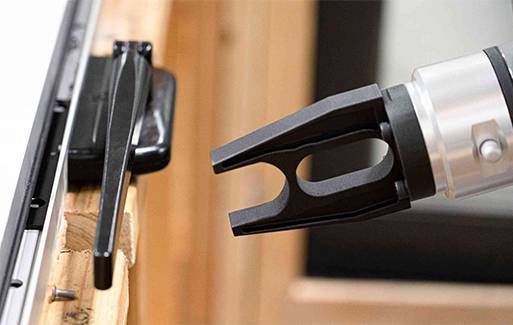
Onyx™ — MarkForged’s flagship Composite Base material — is a micro carbon fibre filled nylon that yields accurate parts with near flawless surface finish. Few materials have the versatility of Onyx; it offers high strength, toughness, and chemical resistance when printed alone, and can be reinforced with Continuous Fibres to yield aluminium-strength parts.
Applications
- Plastic Part Replacement
- Housings
- Sensor Mounts
- Cosmetic Prototypes
Technical Specs
| Tensile Stress at Yield: | 40 MPa |
| Tensile Strain at Break: | 25% |
| Flexural Strength: | 71 MPa |
| Izod Impact – notched: | 330 J/m |
| Colour: | Black |
| Build Size (WxDxH): | 525x400x400 mm |
| Layer Thickness: | 0.125 mm |
For more technical data download the material data sheet.
Onyx FR™
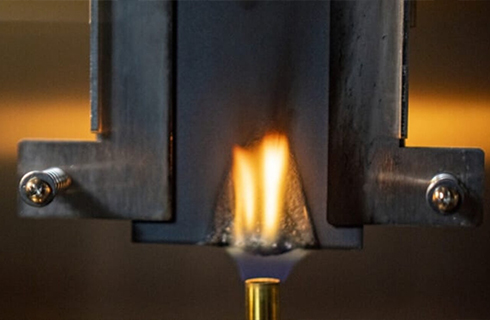
Certified UL 94 V-0 rated flame-retardant micro carbon fibre filled nylon.
Onyx FR is a flame-retardant variant of Onyx designed for use in applications where parts must be non-flammable. The material earned a UL Blue Card, and is considered V-0 (self extinguishing) at thicknesses greater than or equal to 3mm. It can also be reinforced with Continuous Fibre.
Now Available with Traceability with Onyx FR-A
New FR-A materials establish lot-level material traceability and pass the test suite necessary for qualification under 14 CFR 25.853 for most 3D-printable parts.
Onyx FR-A and Carbon Fibre FR-A are purpose-built for the requirements of the aerospace, transportation and automotive industries.
Applications
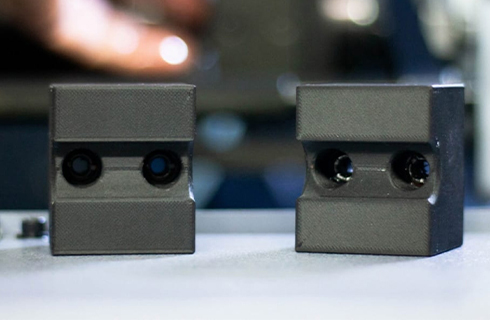
- Weld Fixturing
- Aerospace Clips & Brackets
- Laser Marking Fixtures
- Energy/Electrical Brackets & Fixtures
Technical Specs
| Tensile Stress at Yield: | 41 MPa |
| Tensile Strain at Break: | 18% |
| Flexural Strength: | 71 MPa |
| Izod Impact – notched: | – |
| Colour: | Black |
| Build Size (WxDxH): | 525x400x400 mm |
| Layer Thickness: | 0.125 mm |
For more technical data download the material data sheet.
ULTEM™ 9085
Ultra high performance PEI thermoplastic compatible with continuous carbon fibre
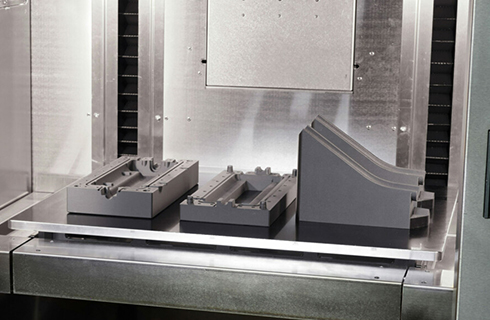
ULTEM™ 9085 is Markforged’s first high temperature printing polymer. It’s an extremely durable thermoplastic that exhibits excellent flame, smoke, and toxicity (FST) characteristics. Usable in production aerospace applications, ULTEM™ Filament brings Markforged’s CFR technology to a new realm of parts.
Applications
- High Temperature Tooling
- Aircraft Interior Panelling
- Aircraft Brackets, Handles, and Knobs
- Custom Ducting
- Composite Moulds and Layup Tools
Technical Specs
| Tensile Stress at Yield: | 68 MPa |
| Tensile Strain at Break: | 5.5% |
| Flexural Strength: | 105 MPa |
| Izod Impact – notched: | 70 J/m |
| Colour: | Black |
| Build Size (WxDxH): | 525x400x400 mm |
| Layer Thickness: | 0.125 mm |
For more technical data download the material data sheet.
Carbon Fibre
*For advanced projects requiring continuous fibre reinforcement, contact us to discuss feasibility and pricing.
The backbone of aluminium-strength composite parts
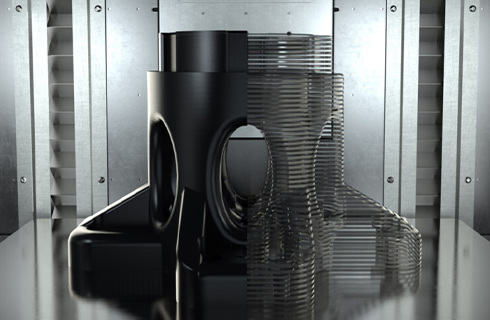
Carbon Fibre is Markforged’s unique, ultra-high-strength Continuous Fibre — when laid into a Composite Base material like Onyx, it can yield parts as strong as 6061-T6 Aluminium. It’s extremely stiff and strong, and can be automatically laid down in a wide variety of geometries by Markforged 3D printers. A special Carbon Fibre variant is compatible with ULTEM™ 9085 Filament.
Applications
- High-Strength Tools & Fixtures
- Brackets & Mounts
- Inspection/CMM Fixturing
- Bespoke End-Use Parts
- Functional Prototypes
Technical Specs
*When printed with Onyx
| Tensile Stress at Yield: | 800 MPa |
| Tensile Strain at Break: | 1.5% |
| Flexural Strength: | 540 MPa |
| Izod Impact – notched: | 960 J/m |
| Colour: | Black |
| Build Size (WxDxH): | 525x400x400 mm |
| Layer Thickness: | 0.125 mm |
For more technical data download the material data sheet.
Carbon Fibre FR
*For advanced projects requiring continuous fibre reinforcement, contact us to discuss feasibility and pricing.
The backbone of flight-ready 3D Printed composites
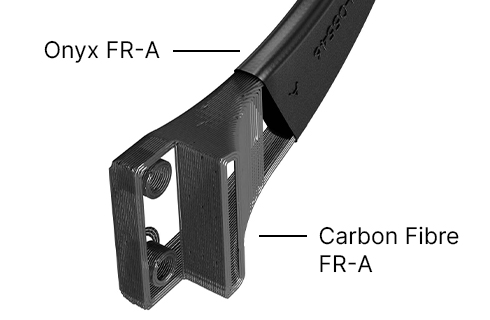
Carbon Fibre FR is a flame-retardant variant of Markforged’s unique, ultra-high-strength Continuous Carbon Fibre — when used to reinforce a Composite Base material like Onyx FR, it can yield parts as strong as 6061-T6 Aluminium. It’s extremely stiff and strong, and can be precisely laid down in a wide variety of geometries. Trace curved features, reinforce holes, and mimic unidirectional fibre layups.
Onyx FR-A and Carbon Fibre FR-A are purpose-built for the requirements of the aerospace, transportation and automotive industries. FR-A materials establish lot-level material traceability and pass the test suite necessary for qualification under 14 CFR 25.853 for most 3D-printable parts.
Applications
- Cabin Components
- Brackets & Mounts
- MRO & Spare Parts
- End-Use Parts
- Functional Prototypes
Technical Specs
*When printed with Onyx
| Tensile Stress at Yield: | 760 MPa |
| Tensile Strain at Break: | 1.6% |
| Flexural Strength: | 540 MPa |
| Izod Impact – notched: | 810 J/m |
| Colour: | Black |
| Build Size (WxDxH): | 525x400x400 mm |
| Layer Thickness: | 0.125 mm |
For more technical data download the material data sheet.
PLA
A reliable, easy to work with material for concept models and general-purpose prototypes.
PLA is one of the most widely used FDM materials, known for its ease of printing and consistent results. It produces parts with a clean surface finish and good dimensional accuracy, making it a practical choice for early-stage design work and visual models.
While not intended for high-stress or high-temperature applications, PLA remains a dependable option wherever speed and cost-effectiveness matter more than mechanical performance.
Applications
- Concept models
- Form and fit prototypes
- Display and presentation models
- Low-load fixtures and jigs
Benefits
- Fast, cost-effective printing
- Clean surface finish
- Good dimensional accuracy
- Wide colour availability

PLA Silk
A visually refined version of PLA, with a smooth, glossy surface finish.
PLA Silk shares the same ease of use as standard PLA, with a distinctive lustrous finish that suits parts where appearance matters as much as function. It’s well suited to presentation pieces and models intended for display, photography or exhibition.
The finish is achieved without additional post-processing, making it an efficient way to produce polished-looking parts straight off the printer.
Applications
- Presentation and display models
- Marketing and exhibition samples
- Decorative components
- Product photography samples
Benefits
- High-gloss, refined surface finish
- No post-processing required for a polished look
- Fast, cost-effective printing
- Good dimensional accuracy

PETG
A tougher, more durable alternative to PLA, suited to functional parts.
PETG combines ease of printing with improved impact resistance, layer adhesion and durability compared to PLA. It holds up well in parts that need to withstand handling, moderate loads or outdoor exposure, while still being straightforward to produce.
Its balance of strength and printability makes it a practical middle ground between general-purpose and high-performance materials.
Applications
- Functional prototypes
- Housings and enclosures
- Jigs and fixtures
- Outdoor or moisture-exposed components
Benefits
- Good impact resistance and durability
- Strong layer adhesion
- Moisture and chemical resistance
- Reliable, consistent printing

ABS
A tough, impact-resistant material widely used for functional and end-use parts.
ABS is a well-established engineering thermoplastic, valued for its strength, impact resistance and ability to handle moderate heat. It’s a common choice for parts that need to survive real-world handling and use, from housings to mechanical components.
Printed on our enclosed, temperature-controlled systems, ABS parts achieve the dimensional stability and consistency needed for functional applications.
Applications
- Housings and enclosures
- Mechanical parts and brackets
- Automotive components
- Jigs and fixtures
Benefits
- Good impact and heat resistance
- Strong mechanical properties
- Suitable for post-processing and finishing
- Dimensionally stable when printed enclosed

ASA
A UV-stable alternative to ABS, built for outdoor and weather-exposed parts.
ASA offers similar mechanical properties to ABS, with significantly better resistance to UV exposure, weathering and colour fading. This makes it the preferred choice for parts that will spend time outdoors or in direct sunlight, without the surface degradation ABS can experience over time.
Its stability and durability suit both functional prototypes and end-use parts destined for long-term outdoor service.
Applications
- Outdoor housings and enclosures
- Automotive and signage components
- Long-term outdoor fixtures
- Weather-exposed brackets and mounts
Benefits
- Excellent UV and weather resistance
- Good impact strength
- Colour and surface stability over time
- Suitable for long-term outdoor use

PC
A high-strength engineering material for demanding, load-bearing applications.
Polycarbonate (PC) is one of the strongest materials available in FDM printing, offering high impact strength, toughness and heat resistance. It’s suited to parts that need to perform under significant mechanical or thermal load, where standard materials fall short.
Printed on our enclosed systems, PC parts achieve the strength and stability needed for demanding functional and end-use applications.
Applications
- High-strength functional parts
- Load-bearing brackets and housings
- Tooling and fixtures
- Parts exposed to elevated temperatures
Benefits
- High impact strength and toughness
- Good heat resistance
- Suitable for demanding mechanical applications
- Dimensionally stable when printed enclosed

PETG ESD
A static-dissipative version of PETG, for parts used around sensitive electronics.
PETG ESD combines the durability and impact resistance of standard PETG with static-dissipative properties, reducing the risk of electrostatic discharge. It’s the right choice for components that will be used, stored or assembled around static-sensitive electronic parts.
It gives you the same toughness and reliability as standard PETG, with the added protection needed wherever static control matters.
Applications
- Electronics housings and trays
- Static-sensitive fixtures and jigs
- Component handling and assembly aids
- Packaging for electronic parts
Benefits
- Static-dissipative properties
- Good impact resistance and durability
- Reliable, consistent printing
- Protects sensitive electronic components


Frequently Asked Questions (FAQ)
Fused Deposition Modelling (FDM) is an additive manufacturing technique that constructs 3D objects by melting and extruding thermoplastic materials in layers. This method is extensively utilised for rapid prototyping and manufacturing functional components.
The Markforged FX20 significantly elevates the FDM printing process by introducing industrial-grade capabilities. It brings about enhanced material options, particularly for producing parts with high strength and flame resistance. The FX20 also introduces the innovative feature of utilising continuous fibre reinforcement within printed parts. This advancement results in parts that possess exceptional strength, rendering them ideal for challenging applications like aerospace and automotive industries.
The Markforged FX20 FDM printing service offers a range of benefits. It delivers parts with outstanding mechanical properties, notably high strength and stiffness. Additionally, the service ensures excellent surface finish for the printed parts, all within a cost-effective price range.
The Markforged FX20 FDM printing service is advantageous for a range of industries that demand durable, robust, and dependable parts. These industries encompass aerospace, automotive, manufacturing, robotics, and any sector that necessitates components built to industrial standards.
Continuous Fibre Reinforcement (CFR) within FDM printing refers to the practice of integrating uninterrupted strands of reinforcing material, such as carbon fibre, directly into the thermoplastic material during the printing process. This integration substantially enhances the mechanical attributes and performance of the printed parts.
Formero focuses on high-performance FDM materials. Although numerous grades of FDM materials are prevalent in the fabber and maker communities, Formero currently provides three specialty materials with our FDM service. These materials are Onyx, Onyx FR, and ULTEM. These options are well-suited for a diverse array of applications and are also compatible with our Continuous Fibre Reinforcement (CFR) printing solution.
Opting for FDM brings several advantages to the table. FDM is recognised for its straightforward process, economical nature, and rapid production of functional prototypes. It’s versatile and applicable across various uses, making it perfect for generating concept models, crafting jigs and fixtures, and manufacturing end-use components.
The precision achievable through FDM printing is influenced by multiple factors such as layer height, printer specifications, and the complexity of the part’s geometry. Specifically, the Markforged FX 20, which we employ, is capable of printing with a layer thickness of 0.125mm. This contributes to the overall precision of the printed components.
Absolutely, FDM-printed parts can undergo post-processing and finishing procedures. Depending on your specific needs, you have a variety of options for post-processing, such as sanding, bead blasting, tumbling, painting, and even incorporating threaded inserts, among others. This flexibility allows you to refine the appearance and functionality of your FDM-printed components as required.
Yes, particularly for FDM parts featuring overhangs, bridges, or intricate geometries, build supports are often necessary. These supports are crucial in preventing deformation or collapse while the printing is in progress. After the printing is done, these supports are removed. You don’t need to worry about this process as we handle the setup and subsequent removal of supports during both the printing and post-processing phases.


